
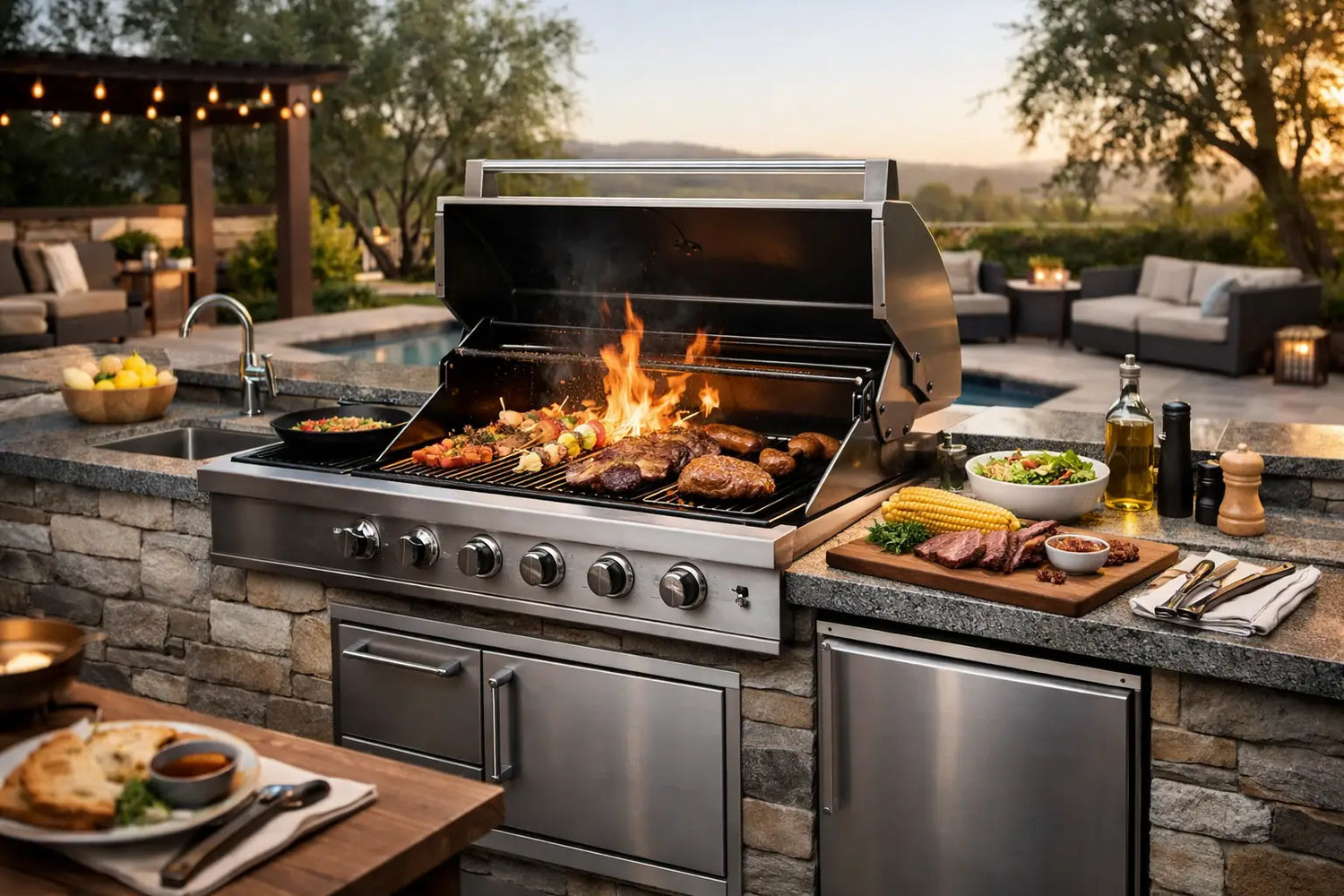
The grill is where most outdoor kitchens either look expertly resolved or slightly improvised. You can see it in the gaps, the awkward clearances, the lid that opens into a wall, the storage that never quite lines up, and the utility connections treated as an afterthought. BBQ integration for outdoor kitchens is not just about fitting a grill into a countertop cutout. It is about making the entire kitchen perform as one finished system.
For homeowners investing in a premium backyard, rooftop, or terrace, that distinction matters. A luxury outdoor kitchen should feel architectural, not pieced together over time. It should support serious cooking, move traffic comfortably during entertaining, and hold up through weather, heat, and daily use without looking compromised after one season.
What BBQ integration for outdoor kitchens really means
At the high end, grill integration is a design and engineering decision, not a decorative one. The BBQ has to work visually with the cabinetry, but it also has to work mechanically with ventilation, clearance, utility routing, prep flow, and storage. If even one of those elements is treated casually, the whole kitchen loses polish.
This is why the best outdoor kitchens are planned around the grill rather than forcing the grill into a layout that was conceived first. The BBQ is usually the anchor appliance. It dictates how much heat management is required, where prep space should sit, how guests circulate, and where accessories such as drawers, side burners, refrigeration, and waste storage make the most sense.
A well-integrated BBQ also protects your investment. Premium grills from brands such as Napoleon, Broil King, and Big Green Egg deserve a housing system built to support their dimensions, operating requirements, and visual weight. When the module is designed for the appliance instead of merely adapted to it, the result looks cleaner and lasts longer.
Why poor grill integration becomes obvious fast
Outdoor kitchens are exposed to hard realities. Heat expands materials. Moisture finds weak edges. Wind affects flame behavior. Guests gather in clusters rather than moving neatly around a floor plan. A layout that looked fine on paper can become frustrating quickly if the grill position was chosen without considering real use.
One of the most common mistakes is underestimating landing space. A high-performance BBQ without generous adjacent work surface turns every cooking session into a juggling act. Another is ignoring lid clearance. Deep hoods and rear-opening lids need room to operate fully, especially near walls, pergola posts, or tall backsplashes.
Then there is the issue of visual balance. In premium outdoor environments, proportion matters. A large grill dropped into a kitchen run that is too short, too shallow, or poorly segmented can make the entire installation feel top-heavy. The opposite problem also happens. A compact grill inside an oversized cabinet arrangement can look lost and underpowered.
Planning the layout around the way you actually cook
The smartest BBQ integration for outdoor kitchens starts with behavior, not only specifications. Do you grill casually on weekends, or do you host large dinners where the cooking zone becomes the social center? Are you cooking for four most nights and twenty on occasion, or is entertaining the primary purpose of the space?
Those answers affect everything. A frequent host usually benefits from more prep area on at least one side of the grill, plus refrigeration and storage nearby so movement stays tight and efficient. A design-focused homeowner with a smaller terrace may prioritize a cleaner linear composition where the BBQ is integrated into a more compact run with disciplined proportions.
For hospitality projects, the priorities can shift again. Service speed, easy cleaning, material resilience, and clear zoning become more critical. The grill should feel fully embedded in a kitchen system that can support repeated use without operational friction.
There is no single perfect layout. There is only the right layout for how the space will be used. That is where premium modular design has a major advantage. It allows the grill to be integrated into a system that already accounts for workflow, material performance, and installation logic, instead of relying on site improvisation.
Built-in look, better execution
Many buyers want the elegance of a built-in BBQ, but traditional custom construction often creates more variables than expected. Site-built installations can be beautiful, but they also depend heavily on contractor accuracy, appliance knowledge, utility planning, and weather timing. When any of those slip, the finish suffers.
A pre-engineered modular system changes the experience. The grill integration is already considered within the cabinet dimensions, support structure, finishes, and service access. That reduces risk in the parts buyers never want to troubleshoot later, such as uneven reveals, poor alignment, difficult maintenance access, or awkward appliance fit.
This is where brands operating at the premium end, including ELEEXA, separate themselves from generic outdoor cabinetry. The value is not simply in selling modules. It is in delivering a refined outdoor kitchen where the BBQ feels native to the design from day one.
Material choices matter more around the grill
The area around a BBQ takes the most punishment in the kitchen. It sees the highest temperatures, the most grease exposure, and frequent contact with tools, platters, and cleaning products. That makes material selection especially important.
Powder-coated metal cabinetry, weather-resistant structural components, and durable countertop surfaces can all perform well, but only when they are chosen for outdoor use and detailed correctly around heat-producing appliances. Finishes need to retain their appearance despite UV exposure and temperature swings. Cabinet interiors should be built to resist moisture, not merely look finished from the outside.
It also pays to think beyond durability alone. In a luxury setting, materials should create visual coherence between the BBQ and the rest of the outdoor environment. The grill should look integrated with the architecture, furniture, and landscaping, not like a professional appliance parked in the middle of a decorative composition.
Compatibility is not a minor detail
Not all grills install the same way, and not every cabinet system accommodates those differences gracefully. Gas grills, kamado cookers, and charcoal units each bring different structural and ventilation considerations. Even within the same category, major brands vary in cutout dimensions, hood profiles, access requirements, and recommended clearances.
That is why compatibility should be resolved early. If the kitchen is designed around a specific appliance ecosystem, the final result is usually far stronger. You avoid filler panels that look forced, support systems that feel improvised, and service access that becomes inconvenient later.
This is especially relevant for buyers who already know the grill brand they want. Matching the outdoor kitchen to the appliance from the beginning creates a more exact fit and a more premium appearance. It also gives more confidence that performance has not been compromised for the sake of aesthetics.
Storage, utilities, and the details people notice later
A grill may be the centerpiece, but the supporting elements determine whether the kitchen feels effortless to use. Storage beneath or adjacent to the BBQ should reflect what happens during real cooking. Tools, trays, fuel accessories, seasonings, and cleaning supplies all need logical placement.
Utility planning deserves the same level of attention. Gas, electric, and lighting requirements should be coordinated so that access remains clean and maintenance does not become invasive. The best integrations hide complexity without making future servicing difficult.
Then there are the subtle details that shape everyday satisfaction - handle alignment, drawer action, heat shielding, panel spacing, countertop overhangs, and the relationship between grill height and prep surface height. These are not flashy talking points, but they are exactly what make a premium outdoor kitchen feel expensive in the right way.
Design should reduce effort, not add it
Luxury buyers are often sold on custom outdoor kitchens by the promise of total freedom. In reality, unlimited choice can create slower timelines, inconsistent execution, and too many decisions pushed back onto the client. BBQ integration for outdoor kitchens should simplify the path to a polished result, not turn it into a project management exercise.
That is the appeal of a plug-and-play approach when it is done at a high level. You still get strong design control, premium finishes, and compatibility with leading grill brands, but without the usual burden of coordinating every trade and solving every fit issue on site. Speed matters, but confidence matters more.
The right outdoor kitchen should arrive as a resolved answer, not a partially finished concept. When the BBQ is properly integrated, the entire space feels calmer, cleaner, and more intentional.
If you are planning a new outdoor kitchen, start with the grill and ask a better question than what fits. Ask what creates the most convincing finished environment. That is where real value lives, and it is what guests notice long before they ever ask about the specs.

