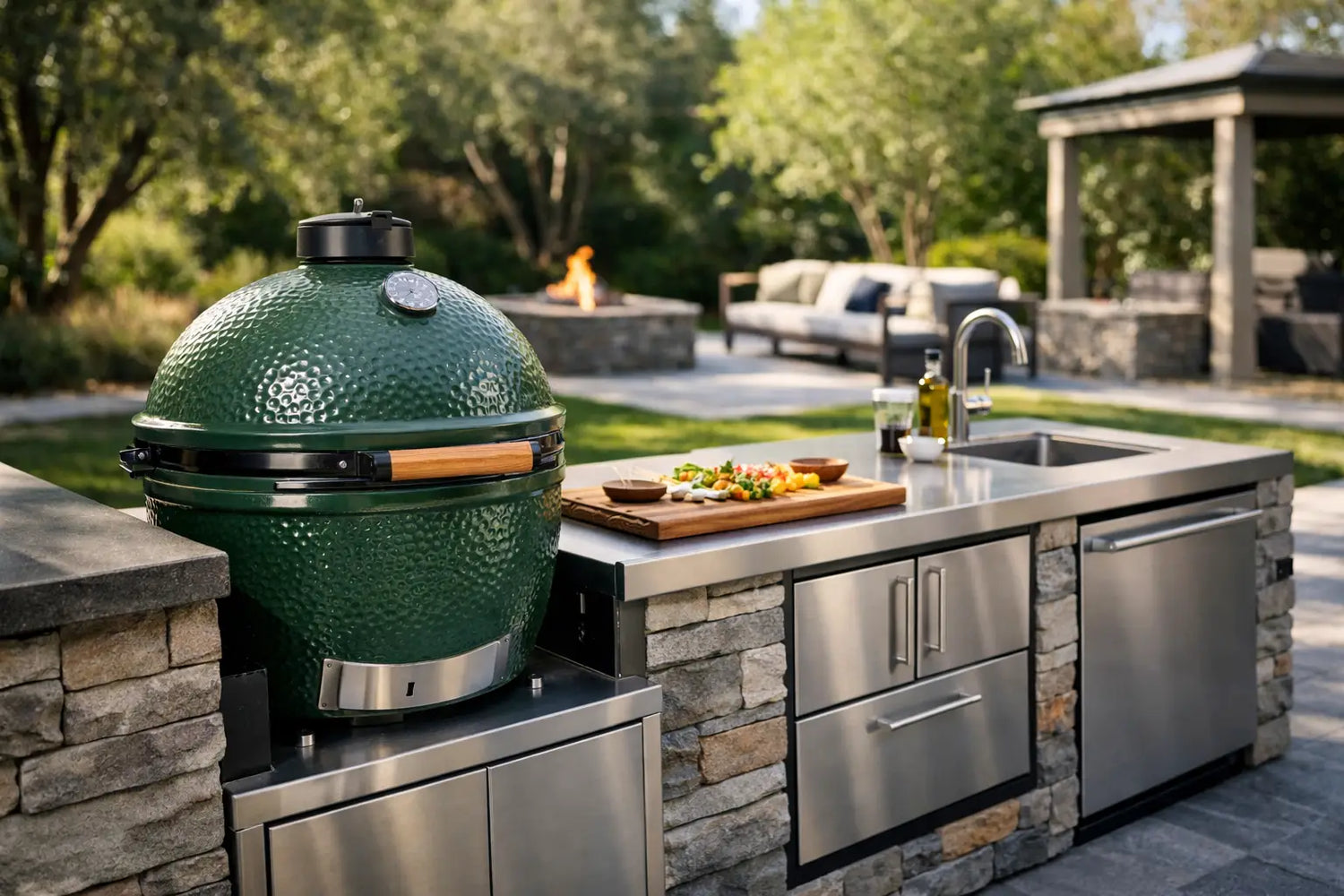
A Big Green Egg deserves better than a cutout in a stone island and a hope that everything lines up. When buyers search for a big green egg outdoor kitchen module, they are usually trying to solve two problems at once: how to integrate a ceramic cooker beautifully, and how to avoid the delays, guesswork, and compromises of a traditional custom build.
That is where the decision gets more interesting than it first appears. A kamado is not just another grill head. It is heavier, rounder, hotter in specific zones, and used differently than a standard gas barbecue. If the module around it is poorly designed, the whole kitchen feels like an afterthought. If it is designed correctly, the Egg becomes the centerpiece of a refined, fully functional outdoor cooking space.
What makes a Big Green Egg outdoor kitchen module different
A Big Green Egg module has to do more than hold the cooker in place. It needs to support substantial weight, create the right opening dimensions, manage airflow around the ceramic body, and leave enough surrounding worktop for prep, plating, and serving. That sounds obvious, yet many outdoor kitchens treat kamado integration as a niche add-on instead of a central design requirement.
There is also the matter of how people actually cook on an Egg. They move between low-and-slow smoking, high-heat searing, and longer hosting sessions that involve charcoal, smoking woods, tools, and trays. A module that works well for a gas grill user may feel awkward for a kamado owner. Storage placement, countertop depth, and access to accessories all matter more here.
For luxury residential projects and hospitality settings, aesthetics matter just as much. The rounded silhouette of the Egg is iconic. The surrounding module should frame it cleanly, not fight it. That means disciplined proportions, premium finishes, and materials that still look exceptional after real weather exposure.
The case for modular instead of custom masonry
Custom-built outdoor kitchens still have appeal. They can be tailored to a site, and on paper they promise unlimited freedom. In practice, they often come with fragmented responsibility, slower timelines, and inconsistent execution. One contractor handles framing, another the countertop, another the appliance cutout, and if the Big Green Egg fit is wrong, the whole process becomes expensive to correct.
A modular route is different. A pre-engineered unit is designed around known dimensions, tested materials, and a repeatable installation method. For buyers investing in a premium outdoor space, that means fewer unknowns and a much faster path from planning to use.
This is especially valuable when the outdoor kitchen is part of a broader architectural setting - a rooftop terrace, a pool house, a villa patio, or a hospitality terrace where downtime carries a cost. The appeal of a plug-and-play system is not simply convenience. It is control. You know what you are getting, how it will fit, and how quickly it can become operational.
How to evaluate a big green egg outdoor kitchen module
The best module is not always the one with the most features. It is the one that fits the way you cook, the way your space is laid out, and the level of finish your property deserves.
Start with exact Egg compatibility
This should be non-negotiable. Big Green Egg models vary in footprint and clearance needs, so the module must be built for the exact size being installed. A vague claim of kamado compatibility is not enough. Precision matters because even a small dimensional mismatch can affect stability, airflow, and visual fit.
The cleanest solutions are purpose-built rather than improvised. They allow the Egg to sit securely while preserving the sleek, integrated look buyers expect from a premium outdoor kitchen.
Look closely at materials
Outdoor kitchens live hard lives. Heat, rain, UV exposure, grease, temperature swings, and cleaning chemicals all take their toll. A beautiful finish in the showroom means very little if it fades, warps, stains, or corrodes after a season.
For a premium module, materials should be selected for long-term exterior performance, not just appearance. Powder-coated aluminum, weather-resistant structural components, and work surfaces built for outdoor use are typically stronger choices than budget cabinetry or site-built solutions that rely too heavily on decorative cladding.
There is a trade-off here. Natural materials can look warm and architectural, but some demand more maintenance. More engineered finishes often offer better resilience and easier ownership. For many buyers, especially in coastal or high-sun locations, lower maintenance wins.
Think beyond the grill opening
A kamado station without useful landing space is frustrating. You need room for trays, tools, sauces, thermometers, and serving boards. If the countertop sections are too narrow, the kitchen becomes visually neat but operationally cramped.
Storage is equally important. Charcoal bags are bulky. Ash tools and cooking accessories add up quickly. A strong module design incorporates drawers or cabinets that make the Egg easier to live with, not just easier to display.
Consider how the module fits a larger kitchen layout
Some buyers only need a dedicated Egg station. Others want the module to sit within a full linear run with prep space, refrigeration, sink options, and additional cooking appliances. That is where modular systems outperform one-off units. They let you start with a focused cooking center and expand into a complete outdoor kitchen with a coherent design language.
A single module can be perfect for a smaller terrace. A larger entertaining space may need a full composition where the Egg is one part of a more ambitious setup. The right answer depends on how often you host, how many people you cook for, and whether your outdoor space is meant for occasional grilling or regular all-day entertaining.
Design details that separate premium from average
A luxury outdoor kitchen should feel resolved from every angle. That means flush lines, well-balanced proportions, quality hardware, and finishes that complement architecture rather than imitate indoor cabinetry outdoors.
This is where many lower-end modules fall short. They may technically house the cooker, but the result feels utilitarian. Premium design gives the Egg a proper stage. It turns a practical cooking appliance into part of the property’s visual identity.
For architects, developers, and hospitality buyers, that difference is not cosmetic. It affects perceived value. A well-designed module can elevate the entire outdoor environment and support a stronger overall impression of the home or venue.
Why pre-assembled matters more than most buyers expect
Assembly burden is often underestimated at the point of purchase. Flat-pack systems and partly finished solutions seem manageable until delivery day arrives. Then come alignment issues, missing components, cutout inaccuracies, and the need to coordinate installers who did not supply the product.
A pre-assembled module removes much of that friction. It arrives with the engineering already resolved, which reduces risk and shortens the path to a finished result. For premium buyers, that is a serious advantage. Luxury is not just about appearance. It is also about avoiding avoidable hassle.
That is one reason brands like ELEEXA have gained traction with design-conscious homeowners and trade buyers alike. The value is not limited to looks. It is the combination of architectural styling, material quality, and a faster, cleaner installation model.
Common mistakes buyers make
The most common mistake is buying around the Egg rather than planning around the full experience of using it. A second is underestimating storage. A third is choosing a module that matches a budget target but not the standard of the property.
There is also a tendency to overbuild. Not every project needs a sprawling kitchen. In some spaces, a single beautifully executed Egg module with generous prep surface is the smarter choice. In others, a full modular kitchen is justified because the outdoor area functions as a true entertaining hub. The best projects are scaled with intention.
Who should invest in a modular Egg kitchen setup
If you care about speed, finish quality, and predictable results, a modular solution makes sense. It is especially compelling for homeowners who do not want a drawn-out custom build, for second-home owners managing projects remotely, and for hospitality operators who need a premium result without long installation disruption.
It also suits buyers who want customization without construction drama. That is the sweet spot: a kitchen that feels bespoke, performs like a professional installation, and arrives with far less site complexity.
A Big Green Egg has a loyal following for good reason. It is versatile, distinctive, and built for serious outdoor cooking. The module around it should meet that same standard. Choose one that respects the cooker, enhances the space, and makes every use feel effortless.