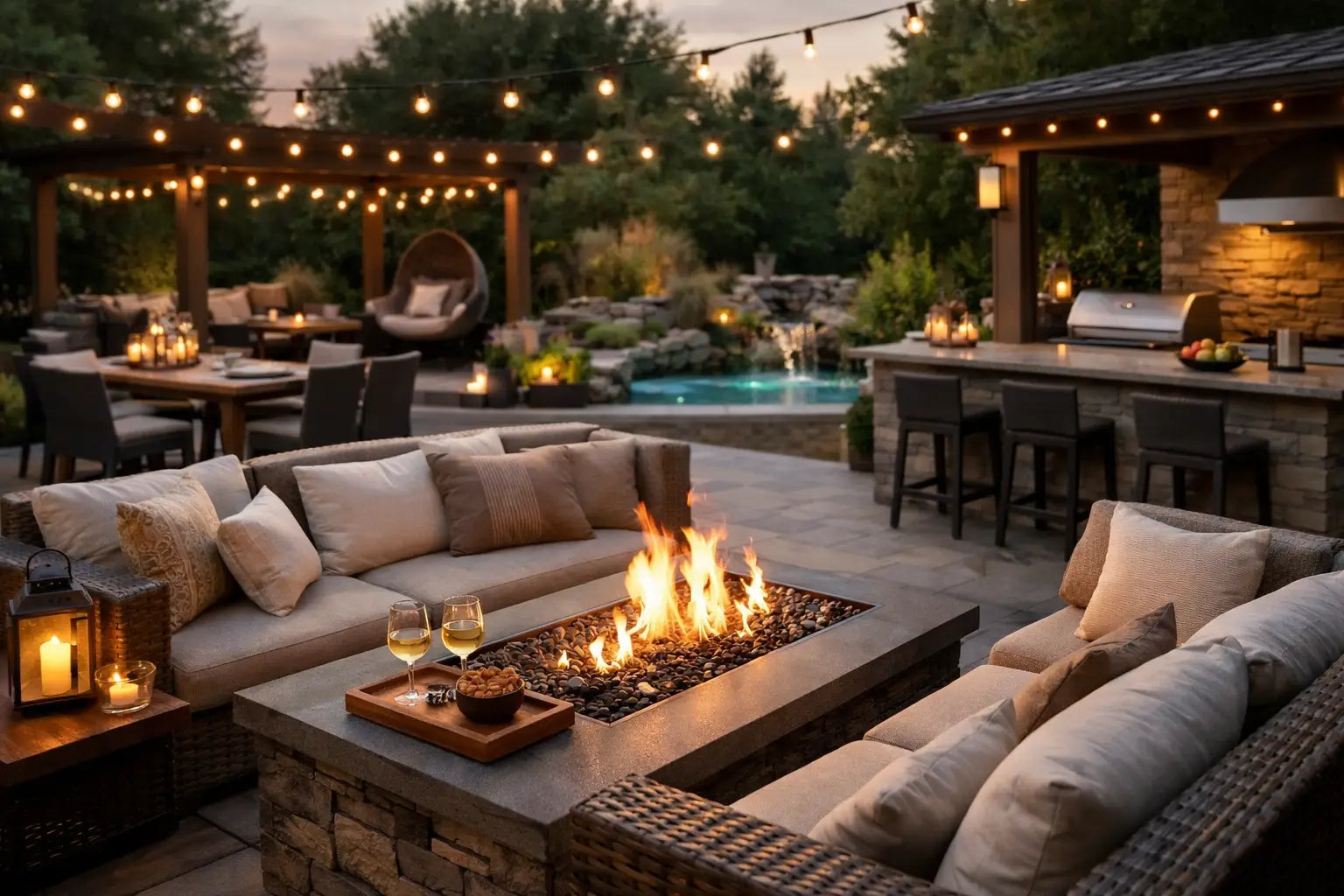
A beautiful grill does not create a complete outdoor kitchen on its own. The cabinetry around it determines whether the space feels considered, functions effortlessly, and continues to look exceptional after years of sun, rain, heat, and entertaining. Knowing how to choose patio cabinetry means looking beyond a color sample or a door style. It means selecting a system designed for your climate, your cooking habits, your architecture, and the way guests move through the space.
For a luxury patio kitchen, cabinetry should do more than hold supplies. It should create a composed outdoor environment where every appliance, utensil, serving piece, and waste bin has a purposeful place. The right choice makes entertaining look easy because the preparation has already been engineered into the design.
Start With the Outdoor Kitchen You Actually Use
The strongest cabinetry decisions begin with behavior, not dimensions. Consider how you cook outside on an ordinary weekend, then consider how the space performs when you host ten people. A compact grilling station needs a different cabinet plan than a full outdoor entertaining kitchen with refrigeration, a sink, side burners, and extended serving space.
If your patio is primarily a place for relaxed family meals, prioritize a generous prep surface beside the grill, drawers for tools and tableware, and concealed waste storage. If you regularly host larger gatherings, a longer run of cabinetry or an island can create a more natural workflow: cold storage and prep at one end, cooking at the center, plating and serving at the other.
Avoid treating every available inch as cabinet space. Outdoor kitchens need breathing room. Clear circulation around an island, comfortable standing space near the grill, and adequate room for doors and drawers to open all affect how premium the finished kitchen feels. In tighter areas, a well-planned linear configuration is often more impressive than an overcrowded L-shaped layout.
Build Around Your Grill and Appliances
Your grill is usually the focal point, but it should not dictate the entire kitchen without consideration. Built-in grills need correctly sized support cabinets, ventilation allowances, and heat-resistant adjacent surfaces. Refrigerators, ice makers, sinks, and power outlets also introduce specific clearance, drainage, and utility requirements.
Choose cabinetry designed to integrate with the exact appliances you want, rather than asking a contractor to make mismatched components work later. Compatibility with established grill ecosystems such as Napoleon, Broil King, or Big Green Egg protects both the visual integrity and technical performance of the kitchen.
This is also where modular systems offer a meaningful advantage. Pre-engineered modules make it easier to combine an appliance cabinet, drawer unit, sink module, and storage cabinet into one coherent composition. You gain the tailored look of a custom kitchen without relying on lengthy on-site fabrication.
Choose Materials Made for Real Weather
Patio cabinetry faces a harsher environment than indoor cabinetry. Sun can fade finishes, moisture can penetrate weak joints, coastal air can accelerate corrosion, and freeze-thaw cycles can test every panel and fastener. A cabinet that looks convincing in a showroom may not be suitable for an exposed terrace or poolside setting.
For premium outdoor use, look for materials that are inherently weather-resistant rather than merely coated for temporary protection. Powder-coated aluminum, high-performance metal structures, marine-grade components, and outdoor-rated composite surfaces are all strong candidates when properly engineered. The key is the complete construction: frames, hinges, drawer slides, fasteners, edges, and ventilation should all be selected for exterior conditions.
Stainless steel remains a classic outdoor choice, particularly for hardware and certain appliance surrounds. Yet not all stainless steel performs equally near the coast. If your property is exposed to salt air, select corrosion-resistant grades and ask how the cabinetry is intended to be maintained in marine environments.
Wood-look finishes can bring warmth to a modern patio, but they must be truly outdoor-rated. Natural wood requires ongoing care and will develop character over time, which some owners appreciate. If you want a more consistent, low-maintenance appearance, engineered exterior finishes often provide the better long-term result.
Match the Finish to Sun, Shade, and Surroundings
Color is not simply a decorative choice outdoors. Dark cabinetry can become hot in direct sun, while very light finishes may show cooking residue or dust more readily. Matte textures can feel architectural and reduce visible fingerprints, whereas smoother finishes may be easier to wipe down after a busy evening.
Think about the wider property as well. Charcoal cabinetry can sharpen a contemporary villa or urban rooftop. Softer stone, taupe, and warm gray finishes can connect an outdoor kitchen to natural paving, timber, or landscaping. The cabinetry should feel like a permanent extension of the home, not a freestanding appliance enclosure.
Prioritize Storage That Supports Entertaining
Exceptional patio cabinetry keeps the working area calm. That requires storage designed around outdoor cooking, not a collection of generic cupboards.
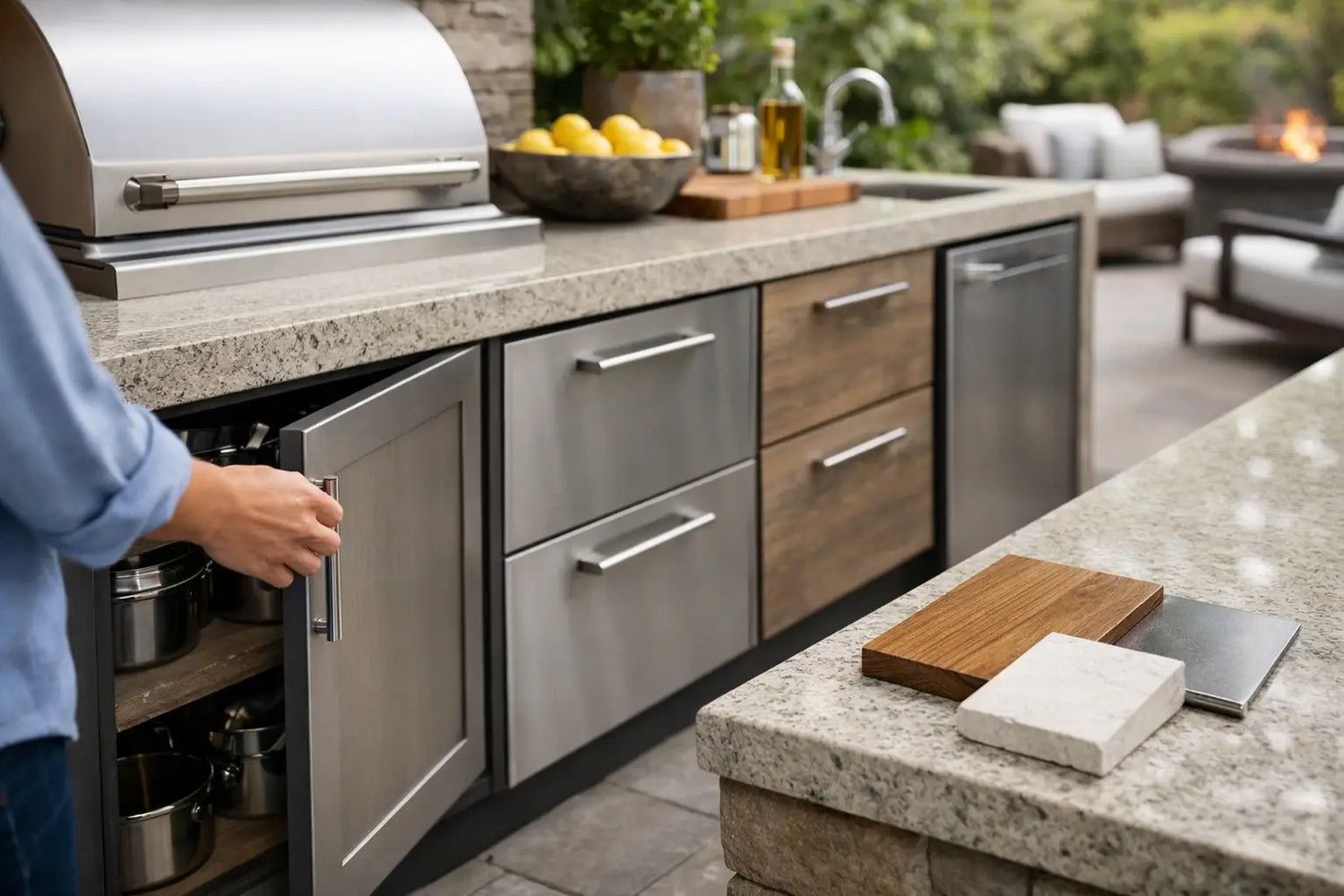
Deep drawers are often more useful than large open cabinets for grill tools, platters, serving boards, and cookware. You can see what you own at a glance, and items do not disappear at the back of a dark compartment. A dedicated pull-out waste solution is another high-value feature, especially when it is located close to the prep zone rather than across the patio.
Consider what should remain outside permanently and what will travel in and out of the house. For example, everyday grilling tools, seasonings, cleaning supplies, and melamine or outdoor tableware deserve dedicated storage. Fine glassware, specialty cookware, or temperature-sensitive ingredients may belong indoors unless your outdoor kitchen includes protected, climate-appropriate storage.
Do not overlook utility storage. A discreet location for a gas bottle, cover, cleaning products, or poolside accessories can preserve the clean visual lines that distinguish a luxury installation. These practical details are often what separate a kitchen that photographs well from one that works beautifully every week.
Evaluate Construction, Not Just the Front Panels
When comparing patio cabinetry, open the doors and drawers. The details reveal the quality. Doors should close with controlled alignment, drawers should glide smoothly under load, and cabinet bases should be designed to sit securely on exterior surfaces that may not be perfectly level.
Ask how the cabinets manage water. Well-designed outdoor cabinetry accounts for drainage, airflow, raised bases, and protected internal areas. Water should not pool around feet, collect inside drawers, or become trapped against exterior walls. For covered patios, these details still matter because wind-driven rain and humidity find their way into spaces that appear sheltered.
Also ask whether the system can be leveled during installation. Patios commonly have a gentle fall for drainage, and cabinetry needs to accommodate that slope without leaving uneven worktops or misaligned doors. This is a small technical feature with an outsized effect on the final result.
Decide Between Custom Build and Modular Precision
A traditional custom-built outdoor kitchen can be appropriate for highly unusual footprints or projects requiring masonry work integrated into the architecture. It can also require multiple trades, extended schedules, site disruption, and more variables to coordinate.
Pre-assembled modular cabinetry offers a more controlled route. The modules are designed, finished, and quality-checked before arriving on site, reducing the uncertainty of outdoor construction. For homeowners and hospitality projects, this can mean faster installation, more predictable results, and far less disruption to a finished landscape or terrace.
The best modular systems do not force a generic outcome. Look for a range of cabinet widths, appliance options, finishes, countertop choices, and end panels that allow the kitchen to be composed for the property. ELEEXA applies this plug-and-play approach to deliver architectural outdoor kitchens without the usual assembly burden.
Plan Utilities Before You Commit
Cabinetry should be selected alongside a practical utility plan. Gas, electricity, water, drainage, and ventilation affect where each module can go and which appliances make sense. A sink may be desirable, for instance, but only if water supply and drainage can be installed cleanly and safely.
For an island, plan power and gas routes before the patio surface is finalized. Retrofitting utilities after paving or decking is complete can be expensive and visually compromising. If utility access is limited, a grill-focused layout with flexible storage may be more intelligent than trying to force a fully equipped kitchen into the wrong location.
Professional electrical and gas installation is essential. Premium cabinetry creates the finished visual framework, but the systems behind it must meet local codes and appliance specifications.
How to Choose Patio Cabinetry With Confidence
The right patio cabinetry is not the option with the most doors, the lowest price, or the boldest finish. It is the system that suits your climate, fits your appliances precisely, protects your investment with exterior-grade engineering, and supports the way you entertain.
Before making a final choice, stand where the kitchen will be installed. Notice the sun path, the prevailing wind, the view from inside the home, and the route guests take to the table. A well-chosen outdoor kitchen becomes part of the architecture of daily life - ready for an impromptu lunch, a late summer gathering, or a quiet evening where everything you need is already exactly where it should be.