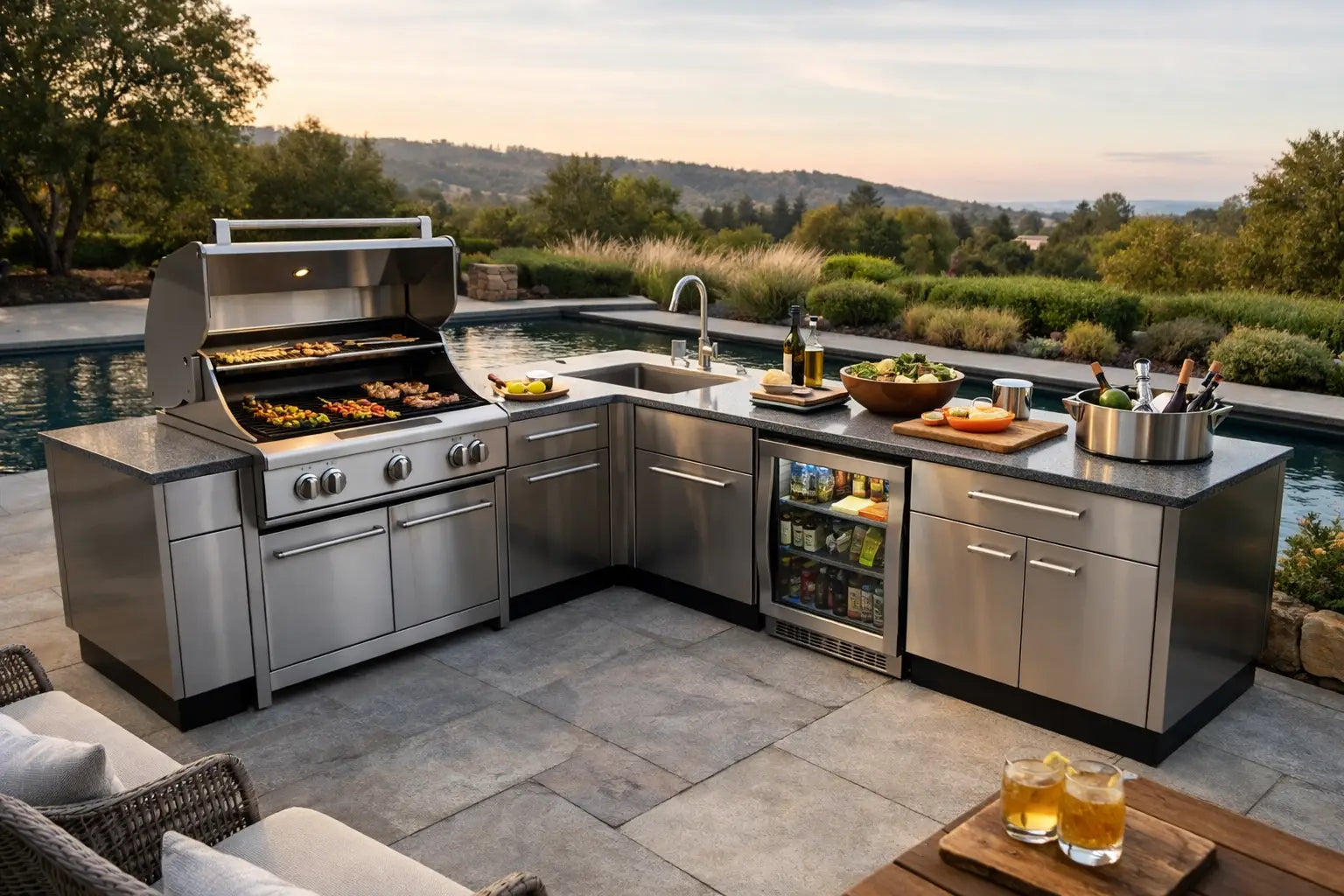
A luxury outdoor kitchen can look perfect on paper and still fail in one expensive place - grill fit. That is why one of the first questions serious buyers ask is what grill brands fit outdoor modules, and the honest answer is: not every brand fits every module, and not every "built-in" grill is truly interchangeable.
The right match comes down to more than width. Cutout dimensions, ventilation requirements, hood clearance, control placement, lid height, and utility routing all shape whether a grill integrates cleanly or becomes a compromise. If you are investing in a premium outdoor kitchen, compatibility should be treated as part of the design, not an afterthought.
What grill brands fit outdoor modules depends on the module design
Some outdoor kitchen systems are built around generic openings. Others are engineered for specific grill families. That difference matters.
A generic module may accommodate several brands if the grill dimensions are close enough, but "close enough" is not the standard you want in a high-end installation. A refined result depends on precise support, proper airflow, safe clearances, and a finished look that does not expose gaps or force awkward filler panels.
A purpose-built module is different. It is designed around the appliance, which usually means a better fit, better proportions, and fewer installation surprises. That is especially valuable when you want the kitchen to feel architectural rather than assembled from mismatched components.
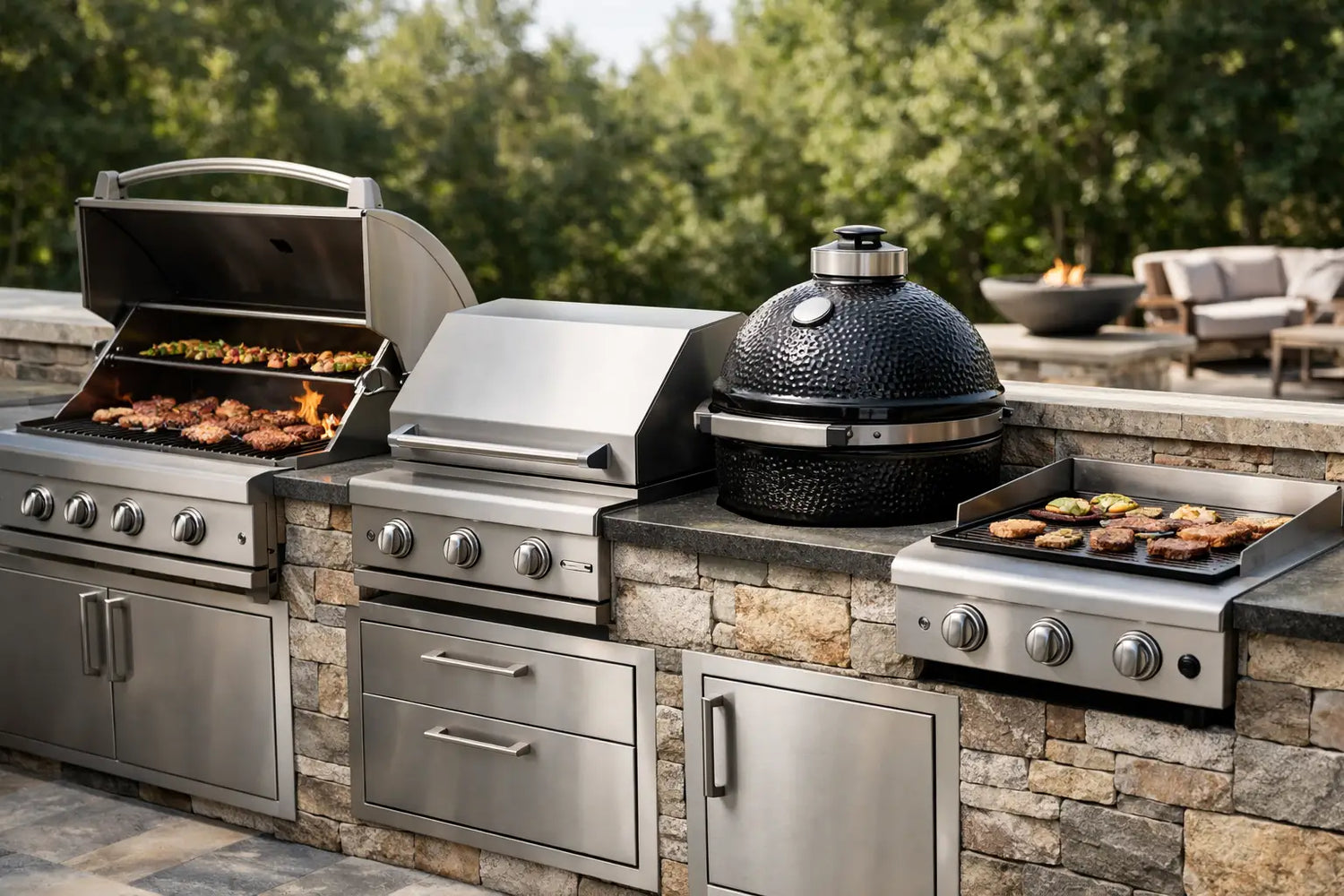
In practice, the grill brands that most often fit outdoor modules well are established premium manufacturers with consistent built-in lines and published technical specifications. Brands such as Napoleon, Broil King, and Big Green Egg are commonly integrated because they have strong market presence, recognizable sizing, and dedicated buyer demand. They also cover different cooking styles, which is important when designing a modular kitchen for a specific lifestyle.
The grill brands most commonly used in outdoor modules
Napoleon
Napoleon is one of the most module-friendly grill brands in the premium market, particularly its built-in gas grills. The brand offers strong performance, a polished visual language, and dimensions that are frequently supported by modular outdoor kitchen manufacturers.
For buyers who want a sleek, contemporary kitchen with a familiar premium grill brand, Napoleon is often a straightforward choice. Its built-in units suit modern linear layouts, and the stainless finish works naturally with luxury cabinetry and stone-inspired surfaces.
The trade-off is that not every Napoleon model shares the same cutout needs. Even within one brand, widths, trim profiles, and hood geometry can vary. If a module is specified for a particular Napoleon series, switching to a different model later may not be simple.
Broil King
Broil King is another strong candidate, especially for buyers who care as much about cooking performance as aesthetics. Its built-in grills are respected for heat output and practical grilling features, and they are often selected for outdoor kitchens that need to perform at a serious level without looking overly commercial.
Broil King tends to appeal to homeowners who actually grill often, not just occasionally entertain. In a modular setting, that can be a smart match because the kitchen is not only beautiful but genuinely useful.
As with Napoleon, model-specific fit is the key point. A brand may be compatible in principle, but the exact grill head, mounting style, and support requirements still need to match the module.
Big Green Egg
Big Green Egg changes the conversation because it is not a standard built-in gas grill. It is a ceramic kamado cooker with its own shape, weight, heat behavior, and installation demands. That means it does fit outdoor modules, but only modules designed specifically for kamado integration.
When integrated properly, a Big Green Egg creates a more distinctive outdoor kitchen. It signals a different cooking culture - slower, more versatile, and more culinary. For design-conscious buyers, it also introduces visual contrast and a premium statement piece.
The caution is obvious. You cannot treat a kamado opening like a gas grill cutout. Weight support, heat management, and access all matter. A true kamado-ready module should account for these factors from the start.
What to check before choosing a grill-module combination
If you are comparing options and asking what grill brands fit outdoor modules, start with technical compatibility rather than brand prestige alone.
First, confirm the exact model number, not just the brand name. "Fits Napoleon" is too vague to guide a purchase. A 32-inch built-in grill and a 38-inch model from the same manufacturer may require completely different openings and internal support.
Second, review the cutout dimensions and the overall product dimensions separately. Buyers often confuse these. The visible grill size does not always tell you what the cabinet opening must be.
Third, check hood clearance. Some grills need more rear and top clearance to open fully, especially when installed near a wall, backsplash, or pergola element. A grill that technically fits can still become frustrating to use if the lid movement is restricted.
Fourth, account for utility access. Gas routing, electrical connections for lighting or rotisserie systems, and ventilation all need room inside the module. Premium outdoor kitchens hide these details well, but they still need to be engineered correctly.
Finally, think about long-term serviceability. A beautiful fit is not enough if the grill is difficult to remove for maintenance or replacement later. The best modular systems balance integrated design with practical access.
Built-in grill modules vs universal grill openings
This is where many buyers separate premium systems from ordinary ones.
A universal opening sounds flexible, and sometimes it is. It can be useful if you have not committed to a grill brand yet or if you want broader replacement options in the future. For some projects, especially early-stage planning, that flexibility is attractive.
But universal solutions often ask you to accept visual and technical compromise. You may end up with filler trim, uneven reveals, or less refined support details. That may be acceptable in a budget-conscious setup, but it is usually not the standard expected in a luxury outdoor kitchen.
A grill-specific module offers a cleaner result. The grill sits as intended, the proportions feel deliberate, and the installation process is faster because fewer variables are left unresolved on site. This is one of the reasons premium modular systems have become so appealing to homeowners, architects, and hospitality buyers - the design is already disciplined before delivery.
Why premium buyers should care about compatibility early
Outdoor kitchens are often planned around layout first: straight run, L-shape, island, bar seating, storage, refrigeration. The grill is then selected later. That sequence creates risk.
The grill is not just another appliance. It is usually the dominant functional element, and it influences cabinet spacing, countertop breaks, safety clearances, and user flow. If compatibility is decided too late, the kitchen may need redesign, custom fillers, or project delays.
This matters even more in hospitality or developer-led projects where timing, repeatability, and finish quality are non-negotiable. A pre-assembled modular system with known grill compatibility reduces site complexity and protects the final look.
For homeowners, the benefit is simpler but just as valuable: fewer surprises, faster installation, and a kitchen that feels resolved from day one.
So, what grill brands fit outdoor modules best?
The strongest answer is that premium outdoor modules most commonly fit built-in models from established brands like Napoleon and Broil King, while specialized modules can also be designed for ceramic systems like Big Green Egg. Those are among the most practical and proven choices because they are widely recognized, performance-driven, and often requested in high-end outdoor kitchen projects.
Still, brand alone is never enough. The best fit depends on the exact grill model, the exact module design, and the level of finish you expect. A module that is engineered around a specific appliance will almost always deliver a better result than one trying to accommodate everything.
That is why sophisticated buyers increasingly favor modular outdoor kitchen manufacturers that design around real grill integrations rather than vague compatibility claims. ELEEXA follows that standard because premium outdoor living should feel precise, not improvised.
When you choose your grill and modules together, the entire kitchen gets better - visually, functionally, and structurally. And that is the difference between an outdoor cooking area that merely works and one that feels fully designed.