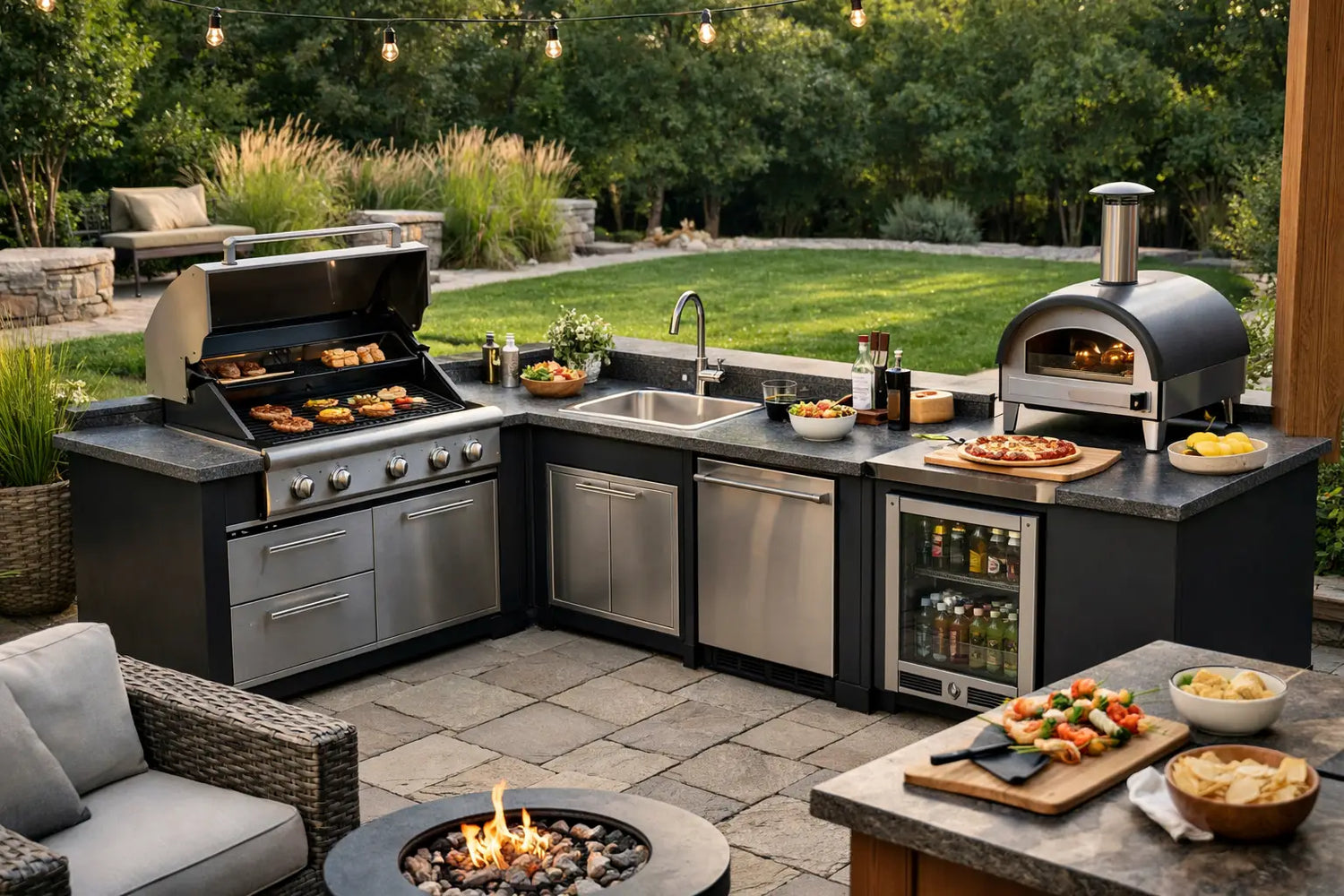
A backyard project can lose its appeal the moment permits, trades, trenching, and weeks of disruption enter the picture. That is exactly why the plug and play outdoor kitchen has become the smarter choice for homeowners and hospitality buyers who want the finished result to feel custom, but the path to get there to feel effortless.
At the premium end of the market, the appeal is not just convenience. It is control. A well-made modular outdoor kitchen arrives pre-assembled, design-led, and ready to integrate into real outdoor living spaces without the usual uncertainty of site-built construction. For buyers investing in a terrace, villa, rooftop, pool house, or resort setting, that changes the decision entirely.
What a plug and play outdoor kitchen really means
The term gets used loosely, so it is worth being precise. A true plug and play outdoor kitchen is not a flat-pack kit and it is not a pile of cabinets waiting for a contractor to interpret a plan. It is a pre-engineered system of outdoor kitchen modules that arrives largely or fully assembled, with appliances and components designed to fit correctly from the start.
That distinction matters. Traditional custom builds often depend on multiple variables going right at once - accurate measurements, skilled labor, proper appliance clearances, weatherproof materials, and clean finishing on site. If one part slips, the whole project drags. A plug and play format removes much of that exposure by shifting complexity out of the backyard and into the manufacturing process, where quality can be controlled.
For the buyer, the benefit is simple: less guesswork, faster installation, and a more predictable result.
Why premium buyers are moving away from custom outdoor builds
For years, custom outdoor kitchens were treated as the gold standard. In reality, custom can be exceptional, but it can also be slow, expensive, and surprisingly inconsistent. That is especially true when the project requires coordination between masonry, electrical work, appliance suppliers, countertop fabricators, and installers who may not regularly build outdoor cooking environments.
A plug and play outdoor kitchen offers a more refined route. The design is resolved upfront. The module dimensions are known. Appliance compatibility is planned in advance. Finishes are selected to work together. Instead of building from scratch on site, the process becomes one of placement and connection.
That does not make modular inherently better in every case. If someone wants a highly unusual footprint wrapped around an existing architectural condition, a fully bespoke site-built solution may still make sense. But for most luxury residential spaces and many hospitality settings, modular pre-assembled systems now deliver the better balance of speed, aesthetics, and reliability.
The biggest advantages of a plug and play system
The most obvious advantage is time. A traditional project can stretch across many weeks, sometimes longer if trades are delayed or materials arrive out of sequence. A pre-assembled system compresses that timeline dramatically because most of the work has already been completed before delivery.
The second advantage is installation simplicity. Buyers with demanding schedules do not want their outdoor living space turned into an active construction zone. A plug and play system reduces site mess, noise, and disruption. That matters in a primary residence, but it matters even more in rental properties, boutique hotels, and hospitality environments where downtime has a direct cost.
There is also a design advantage. Premium modular kitchens are not a compromise if they are engineered well. In fact, they often feel more cohesive than site-built alternatives because finishes, proportions, storage, appliance cutouts, and visual lines are developed as a single product family rather than assembled from disconnected parts.
Then there is durability. Outdoor kitchens fail early when the wrong materials are used or when site finishing leaves vulnerable points exposed to moisture, heat, and temperature swings. A serious plug and play system is designed for weather resistance from the start, using materials and fabrication methods intended for long-term outdoor performance.
What separates premium from ordinary
Not every modular kitchen deserves to be called luxury. The difference is usually visible before you even open a drawer.
Premium systems are defined by architectural design, not utility-first styling. Lines are cleaner. Surface finishes are more refined. Modules feel substantial, not improvised. More important, the engineering beneath that appearance is equally strong. Doors should align properly. Storage should feel precise. Appliance integration should look intentional rather than adapted.
Material quality is another dividing line. Powder-coated metals, weather-resistant cores, marine-grade components, and outdoor-rated work surfaces are not small upgrades. They determine how the kitchen ages in sun, rain, salt air, and daily use. In a luxury outdoor setting, buyers should expect materials that protect both appearance and structure over time.
Compatibility matters too. Many buyers already know which grill ecosystem they want, whether that is Napoleon, Broil King, Big Green Egg, or another premium brand. A high-end modular kitchen should support that decision, not complicate it. Clean appliance integration is one of the clearest signs that the system was built with real-world use in mind.
Is a plug and play outdoor kitchen right for every project?
For many projects, yes. For every project, no.
If the space is straightforward - a linear wall, terrace edge, patio zone, covered outdoor room, rooftop, or poolside entertaining area - modular is often the most intelligent choice. It delivers a polished result without introducing unnecessary construction complexity.
If the site has tight access, highly irregular geometry, or unusual utility conditions, the answer depends on the manufacturer and the planning process. Some modular systems can be configured extensively. Others are more limited. This is where serious pre-purchase guidance matters. A premium supplier should help evaluate access, layout, service requirements, and appliance selection before production begins.
For architects and developers, the calculation is often even clearer. Standardized high-end modules can streamline procurement, reduce installation risk, and improve consistency across multiple units or hospitality settings. That is a major advantage when timelines and finish quality are non-negotiable.
How to evaluate a plug and play outdoor kitchen before buying
The first question is not color or countertop choice. It is whether the system is actually built for outdoors in a premium way. Ask what the core materials are, how the finish performs in weather, and whether the cabinetry is engineered specifically for exterior exposure.
Next, look at assembly and delivery reality. Some brands market convenience, but still require substantial on-site work. Others deliver pre-assembled modules that truly reduce labor. That difference affects timeline, installer cost, and the final appearance.
Then assess configuration flexibility. A luxury buyer should not have to choose between speed and personalization. The best systems allow a tailored layout, integrated appliances, storage planning, and finish selection without collapsing back into the delays of a fully custom build.
Finally, consider visual permanence. Trend-led outdoor kitchens can date quickly. Architectural styling ages better. Strong proportions, restrained detailing, and premium finishes tend to hold their value both aesthetically and financially.
Why this category is growing fast
Outdoor living has matured. Buyers no longer want a grill in a corner and a few loose pieces of furniture. They want a fully resolved entertaining environment that feels as intentional as the interior of the home.
At the same time, patience for fragmented renovation projects is lower than ever. Affluent homeowners value their time. Hospitality operators value speed to revenue. Developers value repeatability. The plug and play model answers all three.
That is why brands such as ELEEXA are gaining attention. The category has moved beyond convenience alone. It now represents a better product logic for many premium spaces - factory-controlled quality, design consistency, faster installation, and a finished result that feels elevated from day one.
The real value is not just easier installation
A well-executed outdoor kitchen changes how a property is used. It extends entertaining season, increases functional living space, and gives the exterior of the home or venue a stronger sense of completeness. But the value is diminished if getting there becomes a drawn-out construction exercise.
That is the strongest argument for a plug and play outdoor kitchen. It protects the experience on both sides of the purchase. The buying process is cleaner. The installation is faster. The result is more predictable. And when the system is built at a premium level, those practical gains do not come at the expense of design.
Luxury outdoor living should feel effortless long before the first dinner is served. Choose a system that delivers that standard from the very beginning.